

“… a sound world both familiar and thrilling, unsettling and provocative.”
Kenton Stevens
4 Turns of the dial
Venue: The Substation, Newport
(Melbourne Fringe)
Dates: to 10th October 2026
Sometimes we are simply predisposed to like something.
Only a few weeks ago, I was deeply engaged by Roslyn Oades & Bob Scott’s immersive telephonic creation The Nightline at the Malthouse. There, amid an array of old rotary telephones and switchboards, set upon tables for one, all individually lit, an audience is drawn into a world of late-night intimacies and human vulnerabilities. Each listener navigates a journey through many nocturnal offerings (to a telephone line you really can call). Each experiences something different, yet together. A sort of sharing in diversity. Then, at moments, a sweeping shift in the soundscape, a passing train or storm or an interplay of lights, connects us in the space and the narrative; albeit, for a moment. Before being plunged, once more, back into threads of peoples’ stories, insights and confessions. That evening, I became aware that several audience members were attending for a second time (maybe more), seeking a new and different experience of the work. The piece resonated with me for many days.
So it was that, in its wake, I visited The Substation in Newport. A wonderful space, itself worthy of mention. Built in the early part of the twentieth century to power Melbourne’s rail system, and defunct by the 1960s, it has been an arts venue for almost twenty years. It is a fine space, and home to Oades and Scott’s Melbourne Fringe Festival offering The Enormous Radio.
An aside. American writer John Cheever’s short story of the same name, set shortly after the Second World War, sees a middle class New York couple replace their broken radio with a new model that has an unexpected superpower. It can tune into and transmit the private sounds and conversations of their neighbours. Eavesdropping on the strangers in their midst, they must explore what and who these people might be, and in turn what and who they are themselves.
Roslyn Oades’ creation asks us to open our ears (and our eyes) to another cradle of communication, Australian native animals, reimagined through human speech. Using field recordings, translation software, and a range of technologies, Oades and her team creatively bridge the gap between what we can hear, and maybe even name and enjoy, and what we might understand.
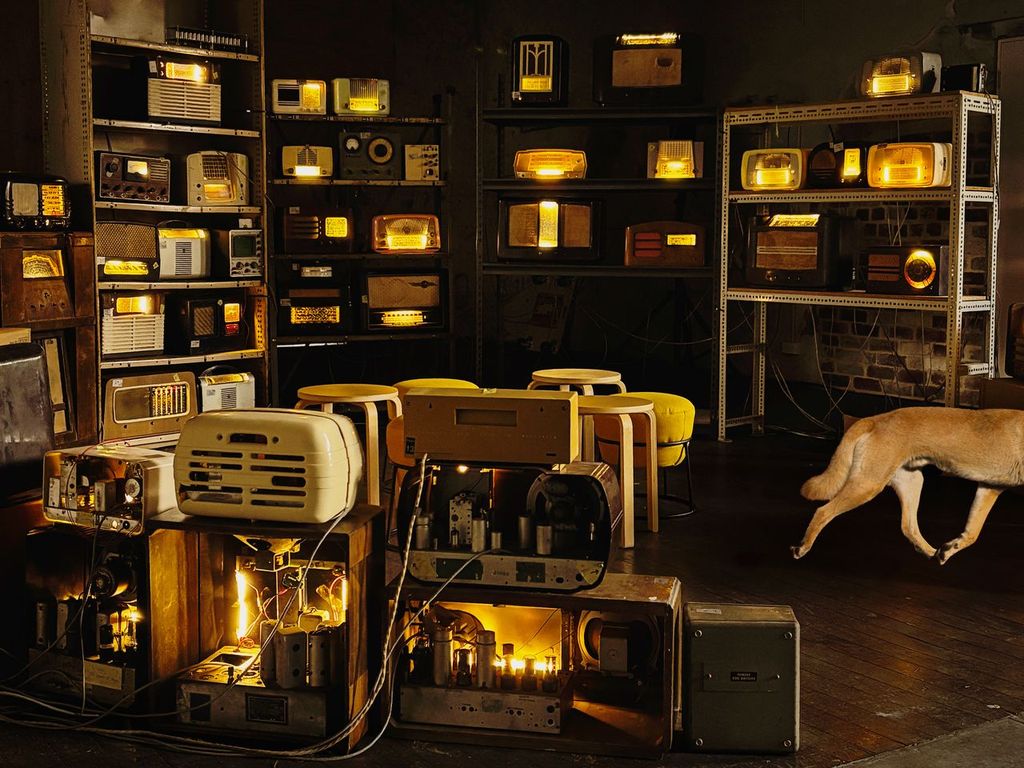
Sitting encircled by a superb collection of twentieth century radios, which surround us with valves aglow, and dials both nostalgic and mesmeric, we settle into an intimate setting which holds but a dozen or so at each showing. These vehicles of communication are energised at first through snippets of radios doing what radios do – sharing news, sport, and insights from well-curated presenters. Soon, however, we are swept up into a sound world both familiar and thrilling, unsettling and provocative. Augmented by smart lighting design (Jenny Hector) that animates the radio sets themselves.
Utterances, snippets of conversation maybe, or cries for help and understanding, are assigned human meaning through stark, eerie, and oftentimes funny, 1970s-style computer text on primitive screens (Sarah Walker), or a human voice rendering words we might just catch.
“You remember us. You do.”
“Murderer.”
“Never.”
From the swirling, disorienting and deeply unsettling bee swarm to the felt experience of rumbling subsonics in the deep sea world of whales, the 360-degree soundscape (Bob Scott) is unrelenting and tremendous. It opens up a possibility; that we might hear, within this river of sound, at once familiar and utterly foreign, a snippet of meaning, an attempt to connect, a different path.
The work is thrilling. It asks fundamental existential questions. About who we are and how we relate, both to the world around us, and to one another. Maybe these sounds, their shifting pitches and rhythms, their beats and intonations, are valiant efforts to meet us where we are.
We built radios to share stories and news, music and ideas, when our human world was still disparate. We hoped we might be more connected over the airwaves. Now those same channels are re-imagined trying to bridge the gap in our understanding, beyond the human, to our fellow creatures. What if we could reach each other, for a moment? What would we learn? How would it change us, and what would we do then?
It is a work that implores us.
“Listen.”
Kenton Stevens, Theatre Now